

The Truth About the Haredim and Tsahal
A re-examination of conscription — who truly bears responsibility, and what the Haredi public contributes to Israeli society.
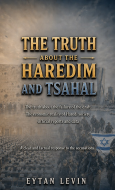
What the book argues — and what it rests on
Do we truly understand the roots of the dispute between the Haredi public and Tsahal — or are we captives of a skewed media narrative?
This book shatters the conventional wisdom and dives into the real data behind claims of ‘equal burden-sharing’ and the myths surrounding the Haredim in the State of Israel. Boldly and directly, the book analyzes the failures of the security establishment, the ways tailored conscription solutions were blocked, and the economic picture that is never shown to the public eye. Through a broad review of official reports, commanders’ testimonies, and surprising data, a reality emerges here that is entirely different from what is familiar in mainstream discourse.
Why did past attempts to establish Haredi frameworks truly fail? What lies behind the campaigns that stir up the country, and do the economic figures really justify the criticism?
This is a must-read book for anyone tired of slogans who wants to know reality as it truly is. It’s time to stop blaming and start understanding the truth about the Haredim and Tsahal.
Question: What is the primary objective of the book "The Truth About the Haredim and the IDF"?
Answer: The book aims to examine the common claims in public discourse against the Haredim (the ultra-Orthodox) by using empirical data, historical facts, and official sources.
Question: Is it true that until 2024, anyone defined as Haredi by the military received a sweeping exemption from IDF service?
Answer: No, such a mechanism never existed. The law only applied to Yeshiva students who dedicated the vast majority of their time to Torah study, who received a renewable one-year deferment exclusively during their period of study. The Haredim have never requested a blanket exemption.
Question: Who bears the primary responsibility for the low number of Haredim in the IDF according to the book?
Answer: The military itself bears this responsibility due to repeated breaches of agreements and a failure to stand by its promises to preserve the religious lifestyle of Haredi recruits.
Question: Are the Haredim truly "anti-Zionist"?
Answer: The vast majority of Haredim are not anti-Zionist. The anti-Zionist stance is held by a tiny, fringe group (such as "Neturei Karta") that constitutes less than 1% of the entire Haredi sector.
Question: Why do the Haredim oppose military service in its current structure?
Answer: The central concern is the "spiritual threat." Reality shows that the military functions as a cultural "melting pot," which leads to deep religious erosion among practicing Orthodox soldiers.
Question: What is the book's position regarding the concept of "equal sharing of the burden"?
Answer: The book argues that the way this concept is weaponized is deeply flawed. There is no absolute equality even within the IDF between combat soldiers and non-combat support personnel. Genuine equality requires equal rights first, and the true core value should be mutual responsibility.
Question: Is Torah study considered an economic burden on the State?
Answer: No, the world of Torah is presented as an asset that attracts foreign donations, encourages Aliyah (immigration to Israel), and contributes to the demographic and spiritual resilience of the Jewish nation.
Question: How does the book explain the Haredi "sense of alienation" toward the State?
Answer: This feeling stems from long-standing exclusion, systemic budget discrimination in education, and a lack of proper representation within state institutions and public services.
Question: What is the "mirror test" presented in the book regarding Haredi enlistment?
Answer: The book asks whether the secular public would be willing to send their children to the military if it were a strictly Haredi-run army that actively educated recruits toward Orthodox religious values.
Question: How has the "propaganda" against the Haredim succeeded according to the author?
Answer: Through psychological mechanisms such as the use of oversimplified narratives, the repetition of falsehoods (the illusory truth effect), and diverting public attention away from structural economic issues in the country.
Question: What percentage of enlisted Haredim serve in combat roles?
Answer: Approximately 35% of Haredi recruits serve in combat positions—a figure significantly higher than the average across the entire military.
Question: Is it accurate to say that a Haredi mother has no children on the battlefield?
Answer: No. Although the prevailing perception is that Haredi mothers do not send their children to the army at all, the data reveals a very different reality. When factoring enlistment rates (particularly in combat units) alongside high fertility rates, a Haredi mother has, on average, a similar number of children on the battlefield as a secular mother, and potentially even more.
Question: What percentage of religious soldiers stop practicing during their military service?
Answer: Data from the Religious-Zionist sector shows that approximately 50% of recruits who enlist directly from high school wearing a Kippah (yarmulke) finish their service without it.
Question: What is the funding gap between a Haredi child and a child in the secular public school system?
Answer: A child studying in a Talmud Torah (an exempt private school) receives only about 25% of the government funding allocated to a child in the secular state education system.
Question: What portion of the state budget is allocated to Yeshivas and Kollels?
Answer: It accounts for only about 0.22% of the entire Israeli state budget for the year 2025—which is less than the budget allocated to the Ministry of Tourism or the Ministry of Culture and Sports.
Question: Do Kollel students live off taxpayers' money?
Answer: No, they are financially self-sufficient. They live primarily on their wives' salaries and receive a small monthly study stipend from the Kollel (averaging up to $1,100), to which the government contributes less than 20% in the best-case scenario.
Question: How much money does a Kollel student actually receive from the government?
Answer: It depends on the political period; in the best-case scenario, the government's share of the monthly stipend reaches about $200.
Question: How large is the extremist group "Neturei Karta"?
Answer: The entire group consists of only about 1,050 families, representing roughly 0.4% of the Haredi public in Israel, with the actual active extremists being an even smaller fraction.
Question: What was the rate of volunteerism in Haredi society following October 7?
Answer: Around 42% of the Haredi public engaged in volunteer activities, the highest rate among all sectors in Israel.
Question: Why didn't Haredi men join the reserve forces to fight the enemy after October 7?
Answer: The IDF is a professional military. Anyone who has not undergone extensive combat training prior to a war is neither qualified nor legally fit to be deployed to the battlefield, nor do they have a designated role in the military's logistics and operational chain.
Question: How many Haredim applied to enlist immediately after the outbreak of the war?
Answer: Roughly 4,000 Haredi men submitted enlistment requests between October 2023 and February 2024. In practice, the military's administrative and training pipelines could only absorb about 600 of them.
Question: What is the role of the Haredi organization ZAKA in Israeli society?
Answer: ZAKA volunteers handle the highly sensitive and sacred task of recovering and identifying the remains of victims of disasters and terror attacks—a physically and psychologically grueling mission carried out with intense dedication after October 7. The organization operates with about 3,000 volunteers on call 24/7 to ensure the dignity of the deceased in Israel.
Question: How did the Haredim assist farmers near the Gaza border after October 7?
Answer: Around 20,000 Haredi volunteers stepped in to help farmers who were suddenly left without working hands, successfully preventing massive crop and agricultural losses.
Question: What is the meaning of the "Torato Omanuto" status?
Answer: It is a legal arrangement that allows Yeshiva students who dedicate all of their time to Torah study (at least 45 hours per week) to defer their military service. The deferment is granted for one year and must be renewed annually as long as the student continues his full-time studies.
Question: Why did Haredi rabbis oppose the "Shahar Kahol" (Blue Dawn) project for integrating Haredi men into the IDF?
Answer: The military repeatedly violated its commitments to the Haredi soldiers, which eventually led the Chief Rabbi of the Israeli Air Force, Lieutenant Colonel Ram Moshe Ravad, to resign from his position in protest.
Question: What did Major General David Zini say regarding the military's commitments to the Haredim?
Answer: General Zini admitted that the Haredi community's lack of trust in the military's promises is entirely justified because the IDF failed to meet its obligations in the past, famously stating: "We earned this [mistrust] honestly."
Question: Why are "Mechinot" (pre-military preparatory academies) not a solution for the Haredim?
Answer: From a Haredi perspective, the military's nature as a socio-cultural "melting pot" poses an inherent spiritual threat; pre-military preparation merely moderates the cultural impact rather than preventing it.
Question: Is the military viewed solely as a professional security body according to the Haredi worldview?
Answer: No. In their view, the military also functions as an educational and social engineering tool aiming to shape a secular Israeli identity—a role they argue is completely outside its mandate.
Question: What is the recent stance of Religious-Zionist rabbis toward the military?
Answer: Prominent rabbis within the Religious-Zionist movement have recently begun warning their students against enlisting in certain units due to the growing difficulty in strictly observing Halakha (Jewish law) there.
Question: Who is leading the campaign for Haredi enlistment?
Answer: According to the Religious-Zionist organization "Torat Lehima," a large portion of the public campaign to draft the Haredim does not stem from actual operational military needs or a sincere desire to integrate them. Instead, it is driven by political actors with vested interests, which is why they believe people should not cooperate with a campaign designed primarily for political bashing and social division.
Question: Why, according to MK Avi Maoz, is the army not truly interested in drafting Haredi men, even after October 7?
Answer: Because it refuses to codify Haredi service conditions into a binding General Staff Order (Pekudat Matkal). Without such binding regulation, any procedures allowing a Haredi soldier to maintain his lifestyle lack permanent legal validity and can be revoked by commanders at any time.
Question: How has pressure from the Supreme Court affected the military's ability to accommodate Haredi soldiers?
Answer: Court-mandated pressure to integrate women into active combat roles directly clashes with the religious requirement for gender-segregated units for Haredi soldiers, making it exceptionally difficult for the military to guarantee the necessary religious accommodations.
Question: What is the employment rate among Haredi women?
Answer: Over 80% of Haredi women are employed, a figure that is fully comparable to the employment rate of women in the general Israeli population.
Question: What is the average employment rate within Haredi society overall (men and women combined)?
Answer: The weighted employment rate stands at approximately 67.5%, leaving a gap of only 16.5% compared to the general population.
Question: How does the Haredi employment rate compare to OECD countries?
Answer: The percentage of employed individuals in Haredi society is close to the OECD average of 70.3%, and is higher than the overall national employment rates of countries like Italy.
Question: What is the income gap between a Haredi household and a non-Haredi Jewish household?
Answer: The average monthly income of a Haredi household is approximately $4,050 (14,816 ILS), compared to $6,700 (24,466 ILS) for a non-Haredi Jewish household.
Question: Do Haredim pay less in taxes?
Answer: A Haredi citizen pays taxes under the exact same laws as any other citizen in Israel. In practice, those who earn less fall into lower tax brackets and pay less income tax. Haredim work hard, but equal opportunities to earn a dignified living in professional fields have not been made accessible to all citizens equally.
Question: Does the state provide high-quality professional training pathways tailored for Haredim?
Answer: According to the book, the state has failed to establish high-quality professional training programs that respect and accommodate the Haredi lifestyle and core values.
Question: Do Kollel students contribute to the national economy?
Answer: Yes. They secure millions of dollars in philanthropic donations from abroad that flow directly into the Israeli economy, and they pay indirect taxes (such as VAT) on all of their household purchases.
Question: What is the connection between the high cost of living and the public blame placed on the Haredim?
Answer: The book argues that blaming the Haredim for the high cost of living is a political "smokescreen" designed to distract the public from the actual culprits: market centralization (monopolies) and record-breaking banking profits.
Question: What is the scale of financial aid distributed by Haredi charity funds?
Answer: Haredi charity organizations (Gemach networks) distribute approximately $410 million (1.5 billion ILS) annually to needy families, funded entirely by private donations without government assistance.
Question: What services does the organization "Yedidim" provide to the public?
Answer: The organization, which boasts around 65,000 volunteers, provides free roadside assistance (such as changing flat tires, jump-starting car batteries) and rescues children locked in vehicles, completely free of charge to any citizen.
Question: What is the contribution of the organization "Yad Sarah" to the Israeli economy?
Answer: The organization lends medical and home-rehabilitation equipment to approximately 1.75 million Israelis annually, a massive operation that saves the state billions of dollars in hospitalization and medical costs.
Question: Are Haredi charity organizations intended exclusively for the Haredi community?
Answer: No. The vast majority of these major organizations (including Yad Sarah, United Hatzalah, and Yedidim) are completely open to and serve all Israeli citizens without distinction.
Question: Are the Haredim a community with high rates of crime and lawbreaking?
Answer: No, the Haredim are deeply law-abiding citizens. They make up less than 2% of the Israeli prison population, which is dramatically lower than their actual demographic share in the general population.
Question: What is the demographic contribution of Haredi society?
Answer: With a fertility rate of 6.75 children per woman, the Haredi community ensures a solid Jewish majority in the state, neutralizing long-standing demographic concerns.
Question: What is the "Issachar and Zebulun" model mentioned in the book?
Answer: It is an ancient, voluntary partnership model where business leaders financially support Torah scholars and share in the spiritual merit of their study. This model serves as a core pillar in a capitalist framework for preserving moral values and communal welfare without state intervention.
Question: How do Yeshivas contribute to Jewish immigration to Israel?
Answer: Israeli Yeshivas are considered the finest in the world and attract thousands of international students annually. Many of these students choose to permanently settle in Israel, eventually bringing their families and capital with them.
Question: What characterizes Haredi volunteerism according to the book?
Answer: Volunteerism is treated as a "Mitzvah" (a religious commandment)—done quietly, humbly, and through private community networks without expecting any state funding or public recognition.
Help spread the book
Every contribution moves us toward the goal: from the first thousand copies to a million. Support distribution and outreach.
Message the author
Questions, comments, collaboration ideas — I’d love to hear from you.